Okay, so, let’s get real. No matter how healthy we want to eat, no matter how much we want our kids to eat the perfect diet, no matter how much we want to avoid processed food, real life exhausts us sometimes.
Even the natural born chefs among us don’t always feel like cooking.
And even the most frugal among us end up eating out eventually. Not only that, but like I mentioned in my last post on fast food, we don’t just eat out for the food. We eat out to be social, to relax, to feel closer to our loved ones and our friends.
So, what do we do when we find ourselves in the “forbidden” restaurant? Sip on a lemon water? Pretend we’re not hungry?
No! We choose healthy or we balance what we eat the rest of the day with what we eat at the restaurant.
Firstly, lets talk about balancing what we eat the rest of the day with what we eat at the restaurant.
When my family decides to eat out, we often eat at Sweet Tomato (Soupplantation). This is because (I’m laughing) Sweet Tomato is our son’s favorite restaurant. Why? Because he likes the macaroni and cheese! I have to twist his arm to get him to eat a tablespoon of shredded carrots or a slice of cucumber with his macaroni and cheese, but he does drink apple juice (that is actually his preference).
Even at Sweet Tomato, the calories add up fast. I generally will eat some of the green salads and my favorite Broccoli Madness as well as a tad of Tuna Tarragon pasta salad. And the herb focaccia is fabulous! I like to try out the monthly soups, though there are a few classic favorites like cream of mushroom, chicken noodle that are my mainstays.
MyFitnessPal has most of the menu items from Sweet Tomato in their database, so I can estimate my calories eaten. Usually, when I eat there, it ends up being around 700 calories. This is over half of my calorie allowance when I don’t work out.
When I eat at Sweet Tomato (or any other restaurant), I try to make sure I go to the gym and workout.
This increases my calorie allowance by an extra 300-500 calories. Also, at Sweet Tomato, the salads and soups have calorie and fat information next to the food. So you can estimate as you go, if you’re into doing that.
So what else can we do when eat out to make sure we don’t completely blow our diet?
Here are 10 healthy choices when eating out I have found to be helpful when eating out.
Check the nutrition facts information on the restaurant’s website. Restaurants are required to make nutrition and allergy information available to customers. 99.9% of restaurants nowadays have websites that you can access anywhere, including your mobile device.
Choose the lower calorie option. For example, if you’re at McDonalds, and you’re itching for a hamburger, buy the smaller hamburger. You can also ask for no sauce. For example, with the Big Mac, you can save 90 calories by ordering it without the sauce.
If you must have the high calorie option, eat half at the restaurant and save the other half for later.
Order just the sandwich and a salad instead of French fries OR order just a salad.
Pay special attention to calories in salads, however. Salads sometimes have more calories than a large cheeseburger, depending on what’s on them.
Use low calorie salad dressing or limit the amount of regular dressing you put on your salad.
Order the sandwich without cheese.
Drink water instead of soda.
Remember that just because it’s healthy doesn’t mean it’s lower in calories. For example, the Green Burrito Bean, Rice and Cheese burrito has more calories than a Carl’s Famous Star with Cheese (Green Burrito and Carl’s Jr exist together at many restaurants, in case you didn’t know that).
What attracts kids to Fast Food? I recently received an email from a subscriber. She wanted advice regarding her 17-year-old son. Her son was raised on a healthy diet since birth, but now only wants to eat at fast food restaurants. This is a concern that I believe many parents have as their kids hit the teen years.
So, what is going on here? Why do teens often prefer to eat at fast food restaurants to eating at home? Is it just about the food? Or is there something else going on that causes so many kids to want to eat more fast food as they get older? In other words, what attracts kids to fast food?
Teens are Exerting their Independence
One of the things about teens is that they are exerting their independence. They want to call the shots. One way they can do that is by taking charge of their own food intake. When they go out and eat at a restaurant, mom and dad don’t have to be there. So, the teen can eat whatever he or she wants. Plus teens usually like being around friends, so eating out becomes an opportunity for social interaction. They could bring their friends home, but that wouldn’t be the same because mom or dad would be there too.
So What Attracts Kids to Fast Food?
I read a book years ago titled, “Fast Food Nation.” It was an excellent book that discussed the psychology behind eating at a fast food restaurant. For example, the author, Eric Schlosser, discusses how eating at McDonald’s is an “experience.” People don’t go to McDonald’s simply because the food is so amazing. They go to McDonald’s because McDonald’s is effective in creating a positive image of themselves as a “Trusted Friend.”
Not only that, Schlosser writes,
“Over the last three decades, fast food has infiltrated every nook and cranny of American Society…Americans now spend more money on fast food than on higher education, personal computers, computer software, or new cars. They spend more on fast food than on movies, books, magazines, newspapers, videos, and recorded music–combined…
“The whole experience of buying fast food has become so routine, so thoroughly unexceptional and mundane, that it is now taken for granted, like brushing your teeth or stopping for a red light. It has become a social custom as American as a small, rectangular, hand-held, frozen, and reheated apple pie.” (emphasis mine).
In other words, kids are growing up in a culture where eating at fast food restaurants is promoted as part of what you’re supposed to do if you’re an American.
In another book, “Consuming Kids,” the author Susan Linn is helpful making the reader more aware of how much money and effort fast food manufacturers spend to make their products attractive to kids. For example, McDonald’s spent $1.3 billion in advertising in 2002 in the US alone. PepsiCo spent more than $1.1 billion. I’m sure it’s much higher today.
So, we can come up with recipes and find healthier “fast food” alternatives that fit in with our busy schedule. And I’m sure this will help encourage our kids to eat healthier at least some of the time. However, we should remember that no matter how good the food is at home, our kids will probably want to eat out more as they get older, especially if they have a lot of friends.
Healthy Fast-Food Picks for Kids
So, what can you do to tempt your child to eat more at home so that you can be sure she is getting the nutrients she needs?
If your teen likes hamburgers, you can serve hamburgers at home.
A hamburger served at home with lean beef or turkey is definitely healthier than a fast food hamburger. Especially since you can use a whole grain roll and offer healthy side dishes, including homemade French fries (see below for recipe). And if making a hamburger from scratch is a burden to you time-wise. There are pre-made burgers available that are definitely more healthy than a Burger King burger is. We shop at Costco, and they have delicious chicken burgers that you can buy and pop in the microwave, pan or BBQ grill for a quick burger. That could help with the time factor.
If your teen likes to eat chicken at fast food restaurants, like KFC, there are alternatives for that too. Again I mention Costco, because they have the best rotisserie chickens! Costco actually loses money when they sell their chickens for $3.99 (not a typo). I have done my research. Costco’s chickens are raised humanely and are free-range, plus they have no added hormones or other junk.
We are a family of three, and one chicken lasts several days. My husband and son like dark meat, and I like white meat. So, we always have extra white meat to use on sandwiches, chicken rice soup, or chicken tomato tacos and burritos.
If you don’t have a Costco nearby or aren’t a member, you can also get Rotisserie chickens at the grocery store. We sometimes get chickens at our regular grocery store, but they aren’t quite as good or as inexpensive. It’s still an option, however. If you are concerned about the ingredients, ask the deli manager about the food prep process.
The chicken nuggets recipe calls for frying the chicken. However, because you are making it at home, you don’t have to worry about the artificial additives used in fast food restaurants. Also, the sodium will be a fraction of the amount of sodium you will get in a restaurant. For example, in our recipe, there is only 91 mg of sodium per serving. In contrast, a four piece order of McDonald’s chicken nuggets contain 340 mg sodium, not to mention a long list of questionable ingredients.
When we made the chicken nuggets the first time, I felt guilty afterward because we fried them and could have baked them. However, my son loved the fried version, but may not have liked the baked ones because they would have been drier.
What Attracts Kids to Fast Food? It’s All About Balance
Like I’ve said in previous posts, homemade will almost always be healthier than processed. Just make sure you use canola, corn, or other unsaturated oil.
Speaking of the oil you use. Years ago, McDonald’s and other fast food restaurants used beef tallow to fry their French fries. Now they use whatever is acceptable at the moment because they don’t want to lose customers. A little trivia for you! 🙂
As an alternative to fast food french fries, homemade fried or baked fries made from fresh potatoes would count as a vegetable. Because french fries are technically a vegetable. The main problem with French fries from a fast food restaurant is that the potatoes aren’t fresh, so the vitamin C is long gone. However, fresh potatoes made at home are high in vitamin C, and the skin is high in iron and fiber. See below for homemade French fries recipe.
A Few Other Ideas
Does your teen like to cook? Maybe he can help with the prep.
It’s obviously a lot more work to make homemade burgers and fries than it is just picking up a burger and fries at your local fast food restaurant. However, if your teen likes cooking, or has elective requirements to meet for high school graduation, you can use this as a teaching and family bonding opportunity.
Does your son or daughter have a favorite vegetable they will eat? One that others in the family like as well? Buying already cut up fresh or frozen is one way to save time. I don’t recommend canned because canned vegetables are filled with sodium. But frozen is almost as healthy as fresh. Plus it has a longer shelf life, so you can stock up for when you are in a hurry or are too tired to cut up vegetables.
Does your teen sometimes grab a burger and bring it home to eat? If he brings a hamburger or something else home with him, you can encourage him to eat a salad or other favorite vegetable with it. There’s also fruit! Making his favorite vegetables and fruits readily available for him to eat can also help to balance the fast-food habit.
The good news is that there are healthy choices at most restaurants. If your teen eats out a lot but tries to order the healthier choices, praise her for it. If not, you can point her to the restaurant food site for nutritional facts to help with making the best decisions.
I’m a Registered Dietitian and I make use of restaurant websites to help me control my calories when I plan to eat out.
Because of government regulations, all restaurants are required to make the nutrition facts available on their menu items.
Hopefully, these tips will help relieve some of the anxiety you have about your teen’s growing independence, attraction to fast food, and other not so healthy food choices.
If you have any other questions, feel free to comment on this post or send me an email. I’d love to hear from you!
For further reading, my own articles on this site:
Not low fat, but still delicious and made from fresh potatoes which are high in Vitamin C and potassium. If you keep the skin on, you also increase the fiber and iron.
Prep Time10 minutesmins
Cook Time15 minutesmins
Total Time25 minutesmins
Course: Side Dish
Cuisine: American
Keyword: frugal, kid friendly recipes
Servings: 4Servings
Calories: 292kcal
Author: Deborah Hanyon, MPH, RDN, ACE-CHC
Ingredients
1CupAvocado oilAmount will depend on size of pan, amount of potatoes made
4LargePotatoesOne potato per person; Russett are best; wash and scrub thoroughly
1tspGarlic SaltLawry's is the one we use because it doesn't have any artificial ingredients
Instructions
Add oil to large non-stick pan
Heat to 375 degrees Fahrenheit
While oil is heating, cut potatoes into wedges. Cut potato in 1/2, and then in 1/2 again, and then 1/2 until wedges are about 3/8' square size.
When oil is ready, add potatoes carefully to pan using a pair of tongs
Cook potatoes until golden brown, about 15 minutes.
Drain on a paper towel covered plate for at least five minutes. Pat french fries with paper towels to remove excess oil.
I have a picky son who absolutely loves Alfredo Sauce. But traditional Alfredo Sauce is through the roof with fat, saturated fat, and calories. Since he eats so much cheese, I’ve been concerned about his heart health. Children today are so much less active than they were when I was growing up, and Nathan is no exception. So, I decided to find a reduced fat Alfredo Sauce to try. (Post may contain affiliate links).
I found a recipe for reduced fat Alfredo Sauce online a few months ago.
We tweaked it a bit. It was a hit! In fact, shortly after trying this recipe, I bought regular Alfredo Sauce at the deli of our local grocery store. If you can believe it, Nathan likes my reduced fat version better. So we make it for him quite frequently.
One thing many people don’t realize about cheese is that dry Italian cheese has richer flavor, and weighs less by bulk. So a 3/4 cup serving of Romano Pecorino cheese has less calories and fat than 3/4 cup of cheddar cheese, for example. This is one reason why this recipe was actually pretty easy to create.
Although Alfredo sauce is traditionally served with Fettucine, you can add this sauce to different types of pasta to add variety. And it will all taste delicious!
We serve our reduced fat Alfredo sauce with Ravioli, whole grain pasta, and legume pasta. It also tastes delicious on vegetables, such as broccoli, and with chicken and beef. We’re still trying to get Nathan used to the idea of eating broccoli, chicken and pasta Alfredo together as one dish. However, he’s not going for it–yet.
The good news is that he will eat chicken and broccoli on the side as long as the pasta is in a separate bowl.
I hope you enjoy this recipe as much as Nathan does. Oh, for comparison.
Delicious, aromatic, and easy. This reduced fat version passes the kid test. You'll be able to serve it with your favorite pasta, meats, and vegetables.
Prep Time20 minutesmins
Cook Time10 minutesmins
Total Time30 minutesmins
Servings: 4Servings
Calories: 358kcal
Author: Deborah Hanyon, MPH, RDN, ACE-CHC
Ingredients
1tbspButter
1tspminced garlic
1tbspall purpose flouror gluten-free flour of choice
1cup2% reduced fat milk
2 tbspcream cheesesoftened
1/2tsplemon zestgrated, fresh
1tbspparsleyfresh, chopped
3/4cupromano pecorinoor other favorite italian cheese
1dashwhite pepperoptional
1/4tspsaltmay use up to 1/2 tsp
8ozwhole grain pastaor other favorite pasta
Instructions
Melt Butter in saucepan
add garlic and lemon zest; cook until soft, about 1 minute
add in flour, stir
add milk, whisk together until smooth; cook, stirring constantly, at medium temp until thickened and bubbly, about 3 minutes
add cream cheese and romano pecorino cheese;
Note that cream cheese will be difficult to completely mix into the milk; if will taste good even if you see little pieces. However, if you want to combine it until it's creamy, you can use an immersion blender.
Add chopped parsley
If you or your can’t tolerate casein or you suspect that you can’t, click to read my article on Casein-Free Dairy Alternatives.
If you’re interested in reading about whether or not food affects autism, click here.
In the bustling kitchen of a homeschooling family, amidst the flurry of flour, the sizzle of the stove, and the laughter of children, something magical happens. Cooking becomes more than just a means of sustenance; it becomes a gateway to learning, creativity, and spiritual nourishment. In Cooking Up Faith, we’ll explore a collection of delicious and nutritious recipes designed to delight the taste buds and feed the soul of your homeschooling family.
The Benefits of Cooking with Kids
Cooking together as a family isn’t just about putting food on the table; it’s an opportunity to cultivate lifelong skills, foster creativity, and strengthen bonds. From measuring ingredients to following recipes, children learn valuable math and reading skills in the kitchen. But perhaps more importantly, they learn about teamwork, patience, and the joy of sharing meals with loved ones. As Proverbs 22:6 reminds us, “Start children off on the way they should go, and even when they are old they will not turn from it.” By involving our children in the cooking process, we lay a foundation for a lifetime of healthy eating habits and family togetherness.
When the demands of homeschooling leave little time for elaborate meal preparation, simplicity is key. Explore a variety of family-friendly recipes that are not only delicious but also quick and easy to make in my Comfort Food Recipes Book as well as in my Quick And Easy Lunches eBook on Teachers Pay Teachers. From hearty soups and salads to one-pan wonders and slow cooker meals, these recipes are designed to fit seamlessly into your busy homeschooling routine. With wholesome ingredients and simple instructions, you can nourish your family’s bodies and spirits without sacrificing precious time or energy. To really save yourself some time and energy, I recommend a meal planner likeLiving Plate RX. It makes planning, prepping, and shopping a week of healthy meals – even for specific diets – a breeze.
Faith-Filled Kitchen Conversations
As you gather around the table to enjoy your delicious creations, let the conversation flow as freely as the food. Use mealtime as an opportunity to discuss faith, values, and life lessons with your children. Share stories from the Bible that relate to the ingredients or dishes you’re enjoying. A wonderful resource to get you started is my God Created bundle on Teachers Pay Teachers. Remember to ask open-ended questions that spark meaningful discussions about God’s provision, gratitude, and the importance of sharing with others. And above all, savor the moments of connection and camaraderie as you break bread together as a family.
Embrace the Power of Shared Meals
Cooking is so much more than just a chore; it’s a labor of love that nourishes both body and soul. As homeschooling families, we have the unique opportunity to turn our kitchens into classrooms, where lessons in math, science, and history are infused with the aroma of homemade goodness and the warmth of family togetherness.
Making sure your child is getting his or her basic nutritional needs met.
Today I’m going to focus on how to avoid (or minimize) the food additives that are detrimental to his or her health.
Since reading the book, “Eating for Autism,” and others like it, I have made quite a few changes to Nathan’s diet. That is, I’ve removed things that I’ve decided aren’t so good for him.
I must be honest when I say that I haven’t noticed any remarkable changes in his behavior, like many have when making these significant changes. However, I still know that it’s making a difference. One of the things about prevention is that you’re preventing it from happening. So, obviously it didn’t happen. You can’t know about something that didn’t happen, right? I believe that’s important to remember.
It’s not just about reducing behavior and allergy issues; it’s about preventing them from happening at all.
The process is complicated and time consuming. However, if you have a child with major behavior issues, who is nonverbal, or has any other extreme symptoms, you may find the time and effort worth it in the end.
The next step is straight forward:
Get Rid of Harmful Toxins
So, what should you strive to remove, or at least reduce, and why? You should eliminate all synthetic food additives because evidence is growing that these additives do affect people who are sensitive.
Food additives include artificial colors, artificial flavors, artificial preservatives, and artificial sweeteners. Click here for partial list
One of the issues with toxins is that there are so many of them in the diet of Americans. And food manufacturers are quite skilled at hiding these worrisome ingredients under different names. For example, MSG (Monosodium Glutamate), which I will talk about in a minute. But first, let’s talk about “GRAS.”
GRAS
“GRAS,” which stands for “Generally Regarded as Safe,” is the label or certification the Food and Drug Administration (FDA) gives when they determine that an ingredient in food is safe to eat. Once a food is labeled as “GRAS,” it’s impossible to get it removed from this list. Unfortunately, many food ingredients that have been labeled GRAS aren’t necessarily safe for everyone.
Here’s what the FDA has to say about GRAS:
“GRAS” is an acronym for the phrase Generally Recognized as Safe. Under sections 201(s) and 409 of the Federal Food, Drug, and Cosmetic Act (the Act), any substance that is intentionally added to food is a food additive, that is subject to premarket review and approval by FDA, unless the substance is generally recognized, among qualified experts, as having been adequately shown to be safe under the conditions of its intended use, or unless the use of the substance is otherwise excepted from the definition of a food additive. (Emphasis Mine)
But if you look at the list of food additives, you might not be feeling so positive about the “safe” part of GRAS, especially when you realize that certain substances were “grandfathered” into the GRAS designation under the Food Additive Amendment of 1958. In other words, they were never really tested for safety before GRAS was slapped on them.
Saccharin, which has been clearly shown to cause bladder cancer in rats, is still on the market because it falls under “GRAS.”
Other ingredients that are labeled as GRAS are questionable, including Aspartame and MSG. Despite the fact that numerous people have reported adverse symptoms to Aspartame and MSG, the FDA refuses to budge on its classification of GRAS for both additives.
So, GRAS was created in an effort by the FDA to monitor food additives. The designation GRAS, according to the FDA, is supposed to mean the food additive is safe for the general public. But kids with ADD, ADHD, and Autism are not the “general public.” And studies are showing that many of these food additives have detrimental effects on these kids and other sensitive people.
Many of these additives contain suspicious ingredients or are created by suspicious means. For example, artificial colors.
Artificial Colors
Most artificial colors contain Coal Tar. Coal Tar is a by-product of coal, and it has been shown to be a carcinogen. So, besides the fact that artificial colors have been shown to increase behavior problems and hyperactivity, there’s the risk of cancer. Coal tar is also used in shampoo, soap, and as a treatment for lice (yikes)!
The current artificial colors used include Blue #1 and #2, Green #3, Red #3 and #40, Yellow #5 and Yellow #6, and Orange. Look for these ingredients on food labels if you want to avoid them.
Artificial Flavors
Artificial flavors are added to food to improve and enhance the flavor of natural food. For example, MSG (Monosodium Glutamate), which is the most common. Do any of you remember the old “Accent” spice? The commercials used to say, “Enhances the flavor of foods.” Well, that’s what Accent is: MSG. In fact, it turns out that Accent is alive and well in the food community. My husband was just in the hospital, and I discovered that they were giving him an Accent packet on his meal trays.
Here is the ingredient list for Accent:
MSG, salt, chili pepper, Tricalcium Phosphate, (anticaking agent), spice (cumin, oregano), Paprika Extractives (color), Garlic Extractives, Onion Extractives, Yellow Lake No. 6, Yellow Lake No. 5.
Hello!!!???
I could not eat Chinese food as a child, because I got sick. I remember one time I was so sick I didn’t even get out of bed. My mom was not happy with me! When I was older, someone told me it was MSG that made me sick. Fast forward to the current day. The food manufacturers still claim it’s all in our head that MSG causes symptoms. Yet many Chinese (and other Asian) restaurants are MSG free.
And the FDA is requiring MSG to be labeled if it is in a particular food. That should make us all wonder.
Some people think MSG is addicting.
For example, many fast foods contain MSG. I have found when I eat a lot of fast food, I want to eat more. In fact, my first job was at McDonald’s. I remember that I always wanted to eat there even on my days off. Addicting? Maybe.
While in college, I read a book titled, “The Slow Poisoning of America.” It seemed extreme at the time, but it did discuss MSG in depth. If you’re interested in reading this book, it is available on Amazon.
Some people believe that MSG is added to foods because of its addictive properties.
Do an internet search under “Is MSG addictive?” and you will see what I mean.
At any rate, if you are interested in removing MSG from your kids’ diets, you will need to learn to identify it on food labels. Unfortunately, it’s not so straight forward. Even though the FDA requires a manufacturer to state “Contains MSG” on the package, food manufacturers figure out ways to avoid putting it on the label.
Glutamate, or glutamic acid, is a naturally occurring amino acid. So, technically it’s “natural.” As a result, if a food contains any form of glutamate (if it’s not actually MSG), it can be labeled under “natural flavors” or “spices.”
Also watch out for the chemicals “disodium inosinate” and “disodium guanylate,” because these are always associated with MSG. Other ingredients that contain glutamate are hydrolyzed vegetable protein, autolyzed yeast, hydrolyzed yeast, yeast extract, soy extracts, and protein isolate.
As you can see, carefully reading labels and doing your research is extremely important, if you want to eliminate or reduce MSG in your family’s diet.
Artificial Food Preservatives
Two artificial food preservatives that have caused controversy are butylated hydroxy anisole “BHA” and butyl hydroxytoluene “BHT.” These two preservatives are used in cereals, certain oils, and in cosmetics.
When I first learned about BHA/BHT, I discovered that Cheerios had them listed as an ingredient. I was really bummed because Cheerios are one of my favorite cereals. Reluctantly, I stopped buying Cheerios after that.
The good news is that Cheerios stopped using that preservative. One day I was in the grocery store, thinking, “Boy some Cheerios really sounds good right now. It’s too bad they contain that cursed ingredient!” Just for fun, I checked the label. It was no longer there! So now my family can eat Cheerios again.
So, read food labels, and re-read them again, because food manufacturers are starting to get the hint that increasing numbers of people don’t want that junk in their food!
Other common preservatives that are often not tolerated and that can be harmful are sulfites and sodium nitrites/nitrates. Sulfites are found in dried fruit, certain aged cheeses, and wine. Nitrites are found in ham, hot dogs, salami, other cold cuts, and bacon. The good news is that there are sulfite free versions of most foods. There are also nitrate free versions of cold cuts as well.
In part 3 of this series, I will discuss specific vitamins and minerals, and why they are important, in more detail.
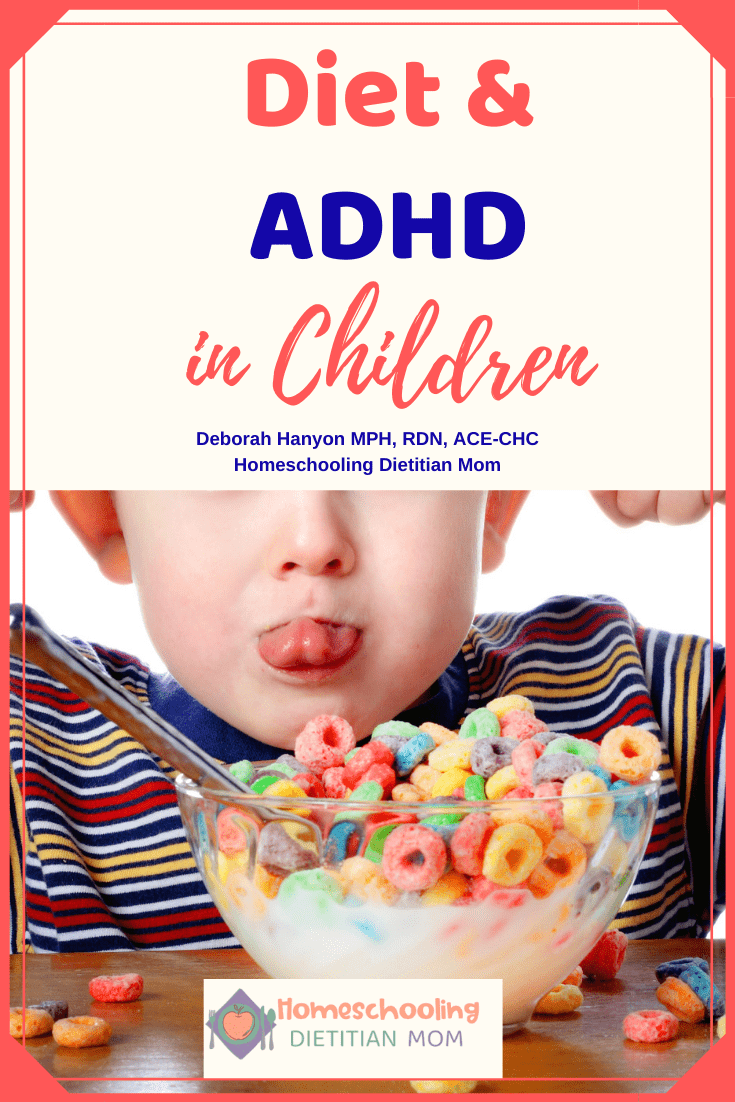
ADHD and Diet in Children – Part 1. My son was diagnosed with ADHD in Kindergarten. I was a Registered Dietitian back then and had been since 2000. However, I admit all I was thinking about back then was keeping his diet balanced. This included ensuring he received enough protein, iron and other essential vitamins and minerals through the foods he ate. I never thought about diet and ADHD in children.
I never seriously thought about food additives to avoid or specifically, “Diet and ADHD in children,” until recently.
Nathan was pickier when he was younger, and he was thin. So, in addition to giving him a multivitamin with iron, I gave him one bottle of Pediasure every day. I also gave him 1000 IU of Vitamin D (and still do) every day. (I take 6,000 IU per day. We use Seeking Health D3 drops).
I started giving Nathan vitamin D after I was diagnosed with vitamin D deficiency. My doctor prescribed a high dose of vitamin D (10,000 IU per day) to counteract the deficiency. The vitamin therapy had amazing effects on my mood–within 3 days I felt better. I was ready to start selling vitamin D, I was so impressed. I’ve struggled with depression in the past, so this was a HUGE deal!
I also noticed that as I continued to take it, I got sick with the cold much less often. To this day, if I get a cold, it’s milder and it doesn’t last as long. This is the same with my son.
More people are realizing that vitamin D is essential for much more than strong bones.
It treats and prevents depression, increases your immune system, and is even helpful for diabetes. However, not everyone is on the bandwagon.
The standard 400 IU is not enough to prevent deficiency in most people, but this is the most common amount on multivitamin labels. In fact, this is still another vitamin that many people are deficient in, and most aren’t even aware of it. (See my articles on Zinc Deficiency and Magnesium Deficiency for two other examples).
The research is still catching up on how important vitamin D is for good health. However, the vitamin D council has the latest, and the most accurate information regarding vitamin D. (Vitamin D is not actually a vitamin. It’s a hormone and is part of the endocrine system). Click here for my article about foods high in Vitamin D.
What about Additives to Avoid?
Okay, so I was satisfied with the fact that Nathan was getting all the most important nutrients through his diet and/or through the supplements I was giving him. One thing I didn’t think about back then, however, was whether there were food additives in his diet that could be contributing to his symptoms. I never asked the question, “Do certain foods or ingredients affect kids with ADHD?”
New Discovery of the Importance of Diet and Children with ADHD
I didn’t start thinking about food additives until Nathan was seven, because I was overwhelmed with all his other issues. And let’s face it. Most doctors don’t emphasize food or nutrition as potential therapy for special kids such as ours. My son’s doctor certainly didn’t.
As a Registered Dietitian Nutritionist, we are required to complete a certain number of continuing education units. So, when it was time to search for that perfect continuing education class, I came across an awesome book titled, “Eating for Autism,” by Elizabeth Strickland. When I read this book, the lights started coming on. And I immediately made changes to further improve Nathan’s health.
For example, I immediately put Nathan on a high-quality Omega-3 supplement. (I will talk more later about why quality is so important and how to know you are getting the best quality). I also changed his multivitamin so that it did not contain any artificial flavors or colors. Previously he was taking Flintstones chewable vitamins, which were prescribed by his pediatrician. He wasn’t taking omega-3s at all before this.
I want to point out a few things that I believe are important to know about children’s multivitamins.
When Nathan’s pediatrician first prescribed multivitamins, I had to tell the pharmacist I wanted iron in the vitamin, because the doctor ordered them without iron. The doctor was worried about the supplement causing constipation. However, a multivitamin with iron only contains 100% of the US RDA and shouldn’t cause constipation (be sure to check with your doctor before making changes like this). Normally, iron causes constipation when taken as a single mineral supplement because it is a larger amount. NOTE: I do not recommend iron supplements without a doctor’s order because of the risk of toxicity.
A separate iron supplement should only be necessary if your child is diagnosed with iron-deficiency anemia (low iron in the blood). This requires a simple blood test. At that point, the risks of constipation outweigh the risks of iron-deficiency anemia.
Cow’s Milk and Iron Deficiency
I previously worked for the Women, Infant, and Children program as a Public Health Nutritionist. While there, I discovered that iron deficiency is common. I also completed my master’s degree project on Iron Deficiency Anemia and its connection to excessive cow’s milk intake. So, this issue is close to heart.
For those interested, the results of the study showed that children who stay on the bottle longer than 12 months are at increased risk of iron deficiency anemia.
This is because:
Cow’s milk has no iron, and in fact too much cow’s milk can interfere with iron absorption (affect the ability of your child to use the iron from other foods)
Drinking from a bottle usually means drinking substantial amounts of milk. Whole milk is high in calories*, and so will fill the child up and make him less interested in other foods (such as iron rich foods).
So, prevention of iron deficiency was important to me before Nathan was even born.
This is because Iron deficiency is serious and should not be taken lightly.
Iron deficiency anemia results in developmental delays, (and can even cause permanent mental retardation, if it’s severe enough, and doesn’t get treated). Iron deficiency also results in increased risk of infection, fatigue, and a whole slew of other issues. Prevention is the best treatment. The good news is that most doctors test for iron deficiency early on. If your child has not been tested. I strongly encourage you to get him or her tested.
It is important to note that if there is no deficiency of iron, and your doctor has not ordered an iron supplement to treat the deficiency, a simple multivitamin with iron should prevent iron deficiency anemia, even if the diet is inadequate in iron.
I gave Nathan the Flintstones vitamins with iron for several years. They were free through his insurance. Once I started learning more about the risks of artificial colors and their effects on kids with ADHD and autism, I started giving him vitamins that don’t contain artificial additives. I paid for these myself, which was worth it to me. Although to be fair to the doctor, she might have been willing to prescribe the healthier ones, I just never asked.
It’s important to know that gummy vitamins do not contain iron.
It can be hard to get your kid to chew healthier multivitamins. This is something I started having problems with. Nathan got to a point where he wouldn’t take the chewable vitamins. Of course, he liked the gummy vitamins. However, I knew he needed iron to prevent anemia, because he wasn’t eating much meat at all (or meat alternatives, such as eggs, beans, peas, nuts, seeds). So, I searched high and low for gummy vitamins that contained iron. I could not find one with iron!
So, if you want your child to get iron in his multivitamin, you’ll need to find another type than gummies.
(If you know of a gummy vitamin with iron, please let me know)!
So, back to the first step to healing. I didn’t necessarily do the steps in order (nor did I even do all the steps. For example, I see no evidence that Nathan is gluten or casein intolerant). However, I’m going to try to talk about them in order–sort of.
Anyone who knows me knows that I tend to jump around from topic to topic when I’m talking. Since I am writing to you, that shouldn’t be too much of a problem!
First, like I discussed above, make sure your child is getting his or her basic nutritional needs met. You can do this by:
Completing a 3-day diary of everything your child eats. (Click here for a basic 3-day food record–it’s free–that I whipped up). Make it as detailed as possible, including serving sizes, brand names, time of day eaten, how much actually eaten, how much your child likes the food. Remember it’s only 3 days! 🙂
Try not to make any changes or improvements during this 3-day period. Don’t judge yourself or your child. No one has to see this except you.
Use MyFitnessPal.com or some other calorie/nutrient calculator to help. MyFitnessPal.com will make it much easier to see any major deficiencies (or excesses) in intake off the top.
For example, proteins, carbohydrates (simple, complex, fiber), fats (saturated, mono and poly, trans), cholesterol
Vitamins A, C, sodium, potassium
This is a good starting point.
After you’ve done a 3-day diary for your children (and yourself, if you’re feeling brave :D), The next is to recognize, and then to avoid (or minimize) synthetic (artificial) food additives that are detrimental to his or her (and your) health.
So, in summary, record and review your children’s and your (whole family’s?) diets. Look for glaring deficiencies. Think about adding a multivitamin with iron (if not already taken) to your child’s diet. Talk to your doctor about having your child tested for iron and/or vitamin D deficiency if you feel it’s a problem.
Click here for a free handout of food combinations that increase absorption of Iron. Hint: Combining iron rich foods and vitamin C rich foods is the key. Click here for recipes and articles on iron rich foods.
In case you don’t already know this. Adobe Reader is free and allows you to type into the document. When you click “Fill and Sign,” it allows you to type on the lines. This is something I just recently discovered.
Grab My Book on Amazon by clicking on the book below.
I only promote products I use and love. Clicking on some of the images on this page will take you to a page of a company I am an affiliate with. If you purchase anything, I will get a small commission.
I only promote products I use and love. Clicking on some of the images on this page will take you to a page of a company I am an affiliate with. If you purchase anything, I will get a small commission.