(Disclaimer: I received a FREE copy of this product through the HOMESCHOOL REVIEW CREW in exchange for my honest review. I was not required to write a positive review nor was I compensated in any other way).
Today, I’m going to tell you a bit about an historical adventure my son and I have been reading for the past several weeks. It’s a book published by YWAM Publishing and is part of the “Heroes of History” series. We both read the book independently and then came together to discuss it.
The Publisher is YWAM Publishing. “YWAM” stands for “Youth with a Mission.”
Generally speaking, YWAM is an organization with a focus on missions, evangelism, and discipleship. Thus, their books are written primarily with this in mind. Since the person Daniel Boone did not to appear to be openly Christian, this book doesn’t have strong Christian themes. However, it is clean, wholesome, and is written as a story, even though it is based on true history.
Needless to say, Daniel Boone was an interesting character, particularly as an adult. For example, once the introductory themes were passed (birth, childhood, etc.), and Daniel started his wilderness adventures, especially as they apply to his contact with the Indians (Native Americans), it became quite suspenseful.
The subject and title of the book is “Daniel Boone – Frontiersman.”
You have probably heard of the name Daniel Boone. However, you may not realize that Daniel Boone was a real person and not just a tall tale. I now understand where the idea of Daniel Boone being a “Tall Tale” came from. The reason why is because of the way the first published book about him was written.
On October 22, 1784, Daniel’s 50th birthday, a book was published about his life thus far. The Title was, “The Discovery, Settlement and Present State of Kentucke..To which is added An Appendix, Containing the Adventures of Col. Daniel Boon,” by John Filson. Apparently, though most of the facts in Filson’s book were correct, it was written like an “epic myth.” So, people reading the book got the idea that Daniel Boone was the hero who had single-handedly opened up the west.
Obviously reality is often less exciting, though not always. It is true that Daniel Boone had his share of adventure. And it is also true that he was a strong leader and a courageous adventurer. But it is also sadly true that he experienced tremendous hardship and loss as did the settlers (and Indians) around him.
If you’ve read biographies and stories from 200 years ago, then you already know that people often died too soon.
Daniel and his wife lost all but one of their daughters, and at least two of their sons. Daniel also lost one of his brothers to Small Pox when he was still young. As a result, Daniel raised his nephew.
I’ve always been disturbed by the lackadaisical attitude that humans had towards animals in the Old West. And this book is no exception.
For example, at one point Daniel mentions that he killed 150 bears in one month for the bear grease. This was the way they survived, but I still find it unsettling. Daniel Boone also discusses the fact that some of his men couldn’t resist the temptation to use buffalos for target practice. They would often kill a buffalo for only the tongue or rump and then leave the rest to rot. As a result of this disgusting behavior, after living in one location for a month, they often had to travel for days to find a buffalo.
Reading about this stuff makes me steaming mad.
However, true history is reality. So, like it or not, it’s important to know it so that we can learn from it and hopefully not repeat it. This is why these books are so perfect for kids to read. They teach history in an interesting way, while sticking with the facts, whether good or bad.
YWAM Publishing provided us with supporting materials to go with our book as well. As a result,
I have also been giving my son assignments which came with the Daniel Boone book.
Below are a few examples of the work he did. My son is 14 and is on the Autism Spectrum. If you knew him, you would know that he is making great strides in his willingness to write down answers with an actual pencil. The final draft is neater and doesn’t have the pictures. Daniel Boone also isn’t all marked up.
Rough draft of one of my son’s assignments.
Rough draft of timeline. Note that I added the letters to make it easier to write the facts. Though the letters worked really well because they take up less space. My son worked on this Timeline for about a week. He processes very slowly, but he finished! 😀
These are words he was required to look up. I took the words out of the unit study given to me with the book. The page numbers were provided as well. He has done all of the words except the last five and has the definitions written in another Word document.
This the main area where Daniel Boone lived (the white area). I added a couple of the states (pencil) for context. He used blue pen to add the letters in white.
A major highlight of the “Heroes of History” book series is the supplementary material available to complement the books. The supplementary materials provide the teacher and/or parent with numerous ideas to use with students. These materials can be used with homeschooling kids as well as with kids in a classroom.
YWAM Publishinghas also published education resources, including outlines, suggestions, and curriculum to go with each of the books in the “Heroes of History” series.
Several style of full unit studies are provided. For example, homeschooling, classroom, and group overviews are provided. These are designed to be directive for any book in the series.
For example, “Using the Heroes of History” to teach US History, Language Arts, Social Studies, and Character Development. Pages of Tables are provided with theme ideas related to each individual book in the series.
These unit studies are excellent tools and will provide hours upon hours of assignment ideas.
In addition, I received a unit study focusing on Daniel Boone alone. This unit study includes numerous activities for every single chapter of the book. An excerpt will illustrate what to expect:
“It provides the schoolteacher and homeschooling parent with ways to use the book as a vehicle for teaching or reinforcing various curriculum areas, including the following:
Also, these materials can be used to fulfill language arts curriculum requirements. Also, history, social studies, and character development.
Like I mentioned above, YWAM Publishing has an entire collection of 72 “Heroes of History” books besides Daniel Boone. For example, Laura Ingalls Wilder, Harriet Tubman, Alan Shepherd, Ben Carson, Clara Barton, Louis Zamperini, and more!
YWAM Publishing also has another series titled, “Christian Heroes: Then and Now.” Thus, if you are interested in learning about famous Christians such as C.S. Lewis and Corrie Ten Boom, you need not look further.
And because these books are written for a younger audience, the stories are gentler, making them more appropriate for young kids. (Though it always a good idea to review a book before giving it to your child to read, especially if you have a sensitive child).
There are so many interesting “Heroes of History” books to choose from, I had a hard time choosing just one!
The reason I chose Daniel Boone is because I knew virtually nothing about him and because I thought my son would enjoy learning about him as well. I have a couple of YWAM Publishing books that I previously purchased before my son was born. I have been waiting for the right time for my son. After reading Daniel Boone, I am looking forward to reading the other two books we own. Since we now have the complementary unit studies, we’ll be able to do more than just read, which is just SO COOL!
To see what the rest of the Homeschool Review Crew thinks about the “Heroes of History” and “Christian Heroes: Then and Now” series, click the image below.
(Disclaimer: I received a FREE copy of this product through the HOMESCHOOL REVIEW CREW in exchange for my honest review. I was not
required to write a positive review nor was I compensated in any other way).
5 Exciting Ways to Travel to the Middle Ages
My son has always enjoyed hands-on activities. He continues to learn this way, and to have a much better attitude when I assign multi-sensory activities, despite that he is in 9th grade*. Though he likes history, he absolutely despises writing essays. Thus, the Home School in the Woods Project Passport World History Studies was a great match for us to study history.
This year we have dabbled in a few scattered activities for variety in our history studies. For example, we started out the school year reviewing the US Presidents. We also spent a couple of months studying Christian Martyrs from early AD years as well as a little bit of time focusing on geography. Despite these interesting projects, we were ready for something new and exciting. Especially since it was wintertime.
To give you a feel for what the theme is for the Project Passport World History Studies curriculum, I am inviting you to travel for a short time with me to get a taste of what you might get if you traveled to the Middle Ages. And if you and your children like the idea of traveling to another time and place, you can purchase the inexpensive curriculum yourself.
As you can see from the photos below, that’s exactly what your kids will do when they begin “traveling” to the Middle Ages. They will first need to prepare by creating their passport and getting their luggage ready. This is a very challenging project, so be sure to read the directions very carefully as you go through these projects so you don’t make a mistake. We went through 3 folders before we got it right. But it was worth it! What a cool project this was. The time spent flew by and I didn’t get any complaints which is pretty common occurrance normally.
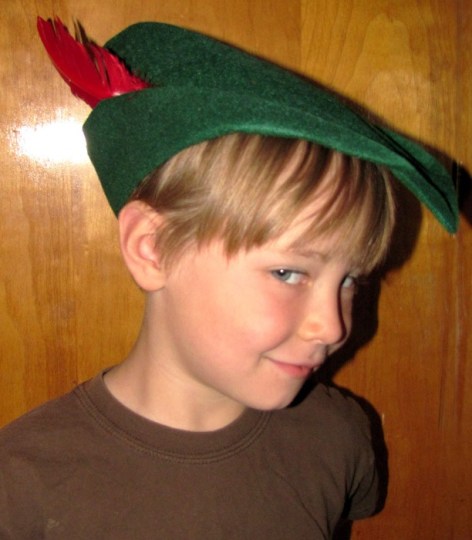
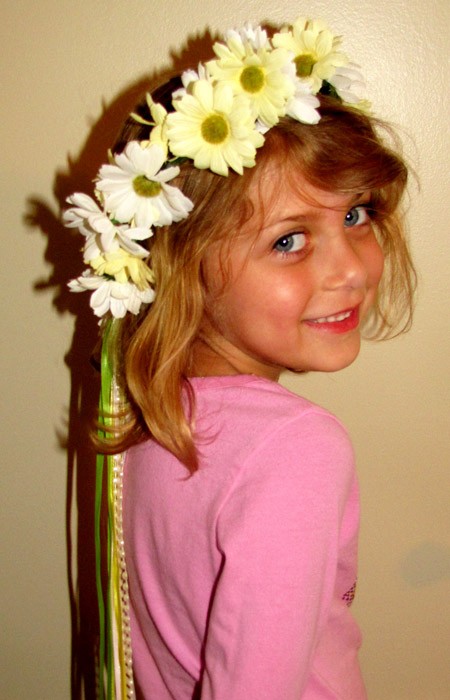
2. Dress up like a Serf, King, Knight, or Commoner (and learn about costumes and Middle Ages fashion trends)
Or if you’re short of time or resources, you can start with studies of some of the fashion trends. Your kids will have lots of opportunities to color. Interesting thing about coloring. When my son was younger, he hated coloring and would only scribble. Now he does an amazing job when I assign coloring projects. (Nathan colored the knight and horse below—he always has to add his take on everything)!
We are in the middle of a COVID-19 pandemic as I write this review. So, we’re kind of stuck at home. As a result, we couldn’t go out shopping at the local thrift store for cool fabrics and gadgets to use for dress up. However, my son dressed up his Knight (see below). Plus, we are currently working on puppets and will be doing a puppet show.
3. Create puppets and act out a skit
Not too many things can bring you to another time and place as quickly as acting out a play or skit such as a puppet show. All of the directions are included for this project. You simply have to plan ahead and make sure you have everything you need before you start, and I am sure that you and your kids will have a ton of fun with this project.
4. Cook a Middle Ages Feast (and Make Marzipan out of Clay)
No, but seriously! I know you are just dying to try out the Gruel and Blawmanger! Really, most of these foods are much tastier than they look. And you will definitely get a more authentic feel for the way dinnertime was experienced while working through this project.
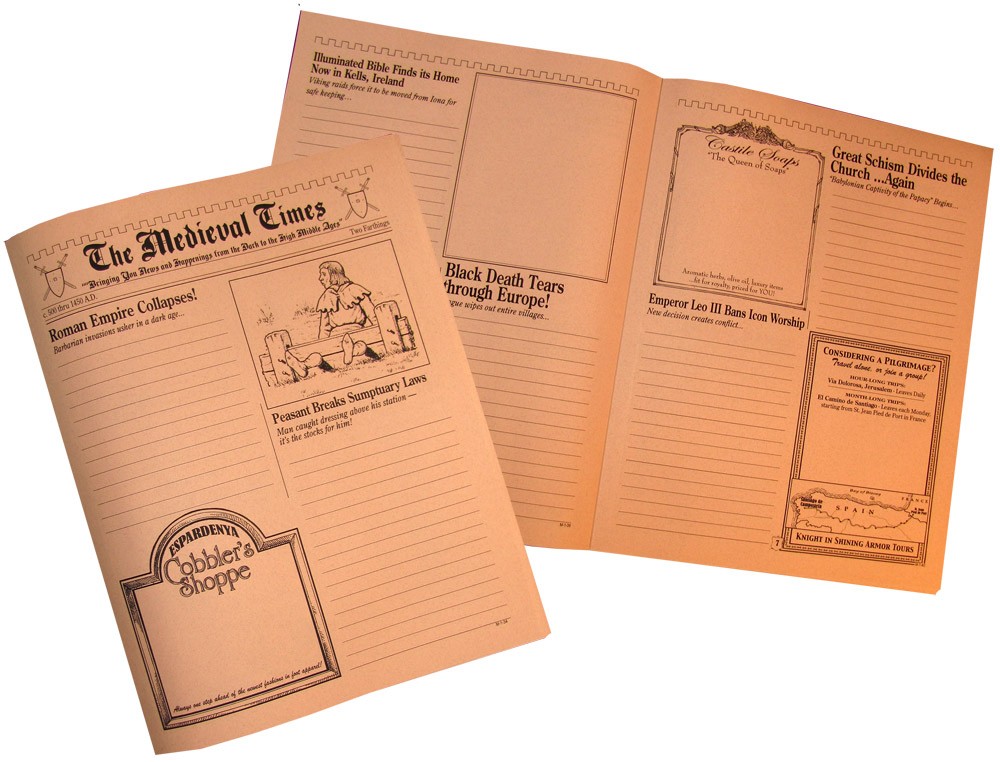
5. Make an Old-Fashioned Middle Ages Newspaper and Write Stories Based on True History
Remember I mentioned that my son hates writing? Here’s the thing.
If I would have required him to write a summary of the history we studied, as opposed to allowing him to cut and paste the portions in the actual essay like you see in my example below, it would look like he didn’t have a clue.
But the fact is, this method that I use to help him get his ideas out on paper is a perfect example of how oftentimes our kids have a lot more knowledge in their head than what is showing up on paper. I find these kinds of projects amazingly encouraging and also I believe it encourages my son to know that he is smarter than he thinks.
If your child can pull sentences out of a two to three page essay, put them in the correct order, and create a summary, then you can be sure he or she understands what they have studied.
Lots of other activity choices are available in Home School in the Woods’ multi-sensory Middle Ages history and social studies curriculum. For example:
Make a Tapistry
Build a Castle
Build a Catapult
Learn about Iconoclasts
Study the Geography of the Roman Empire before and after the fall of the West.
Learn about the Barbarians and Attila the Hun
Create a full Lap Book (see below two pictures for examples of the finished Lapbook. (This is only a sample, there’s much more)!
*And with the 2020 Presidential election just a few months away, be sure to check out the super cool Lap-Pak: U.S. Elections! With the upcoming election in November 2020, this is the perfect time to provide your kids with a fun hands-on activity to help them understand and apply the facts of our political process.
There is a lot of hype these days over the idea of Superfoods. So, I thought it would be appropriate to discuss some of the foods. But first a definition. A Superfood is defined as “a nutrient-rich food especially beneficial for health and well-being.”
I created this recipe myself years ago when I had cottage cheese in the house and wanted to make it more interesting. This will make a complete meal with a few whole grain crackers or slice of bread on the side.
Prep Time10 minutesmins
Total Time10 minutesmins
Servings: 4
Calories: 204kcal
Author: Deborah Hanyon, MPH, RDN, ACE-CHC
Ingredients
2wholeAvocadoscut in half, pitted and sliced
2cupLow-fat cottage cheese
2 tbspSalsa
Instructions
Cut avocados in half; remove pit, peel and slice
place 1/2 cup cottage cheese on small plate or bowl
place 1/2 of avocado around the outside rim of cottage cheese
add salsa to top of cottage cheese
Beets
The vibrant color of beets is your first clue that these unique vegetables are highly nutritious. But what is the nutrient behind the color of beets? The nutrients are called “Betalains.”
Betalains are members of the carotenoid family. Carotenoids are rich in antioxidants. Antioxidants protect against damage from the sun and other environmental toxins.
To help you get a chance to try beets, below is a recipe my husband likes to make.
*NOTE: Beets are an excellent source of natural food colorings. Click here for an awesome website that teaches all about natural dyes, including beets.
Fresh or frozen will do. This recipe uses frozen which can be purchased at Trader Joes or other grocery stores.
Servings: 5
Calories: 61kcal
Author: Deborah Hanyon, MPH, RDN, ACE-CHC
Ingredients
16ozBeetsfrozen
1cupOrange juice
Instructions
Put frozen beets and 1 cup orange juice into saucepan
Cook at medium heat until tender, about 10 minutes (add water if needed)
Apple Cider Vinegar
Apple cider vinegar is the result of the fermentation of apple cider, which is made from fresh, crushed apples, including the cores, peels, and flesh.
Fermentation occurs when yeast is added to the apple cider mixture. This process produces acetic acid, also known as apple cider vinegar.
The healthiest form of apple cider vinegar is the unfiltered, unpasteurized form. This is because the enzymes remain active.
Regardless of whether it is pasteurized or not, however, studies show that the acidity in apple cider vinegar protects the stomach against pathogens.
The acid stimulates the production of hydrochloric acid in the stomach, which is essential for proper digestion.
In some studies, apple cider vinegar caused leukemia cell death and inhibited tumor growth.
Apple Cider vinegar is also a source of polyphenols, protective ingredients found in plants.
Interesting Folklore on Apple Cider Vinegar
1. Hippocrates used vinegar to manage wounds.
2. Hannibal of Carthage used vinegar to dissolve boulders that blocked his army’s path.
3. Cleopatra dissolved precious pearls in vinegar and offered her love potion to Anthony.
4. Sung Tse advocated hand washing with sulfur and vinegar to avoid infection during autopsies.
Smoothie bowls… the delicious concoctions that have quickly become everybody’s favorite breakfast-snack-dessert-treat. This Antioxidant-Rich Beet and Berry Smoothie Bowl is made with probiotic-rich yogurt, healthy avocados, and bright pink beets and berries. It’s easy and full of protein whenever hunger strikes! Click here for the free recipe.
Grab My Book on Amazon by clicking on the book below.
I only promote products I use and love. Clicking on some of the images on this page will take you to a page of a company I am an affiliate with. If you purchase anything, I will get a small commission.
I only promote products I use and love. Clicking on some of the images on this page will take you to a page of a company I am an affiliate with. If you purchase anything, I will get a small commission.