by Deborah Hanyon, MPH, RDN, ACE-CHC | Mar 3, 2019 | Getting Kids Moving, Homeschooling
I was planning to write a post specifically about exercise and autism. However, I have noticed that I have readers with all different types of kids (DUH, right)? And as someone pointed out, all kids are unique learners. So, I’m going to broaden my focus a little. I’m going to talk about how to motivate your kids to exercise. I’m also going to talk about how to improve the conditioning of your child no matter what is his or her preferred activity or exercise. In my son’s case, it is swimming. (Post may contain affiliate links).
I have to be honest here.
I haven’t been the ideal model when it comes to motivating my son to exercise.
Sure, I’m exercising almost daily. So I am modeling the importance of exercise.
But getting my son motivated to exercise is a whole different story.
It might be a bit selfish, but I struggle with fitting in my exercise routine AND motivating my son to exercise as well. This is partly because he’s not interested in getting on the treadmill or riding the elliptical or any of the other things I like to do at the gym. In fact (LOL), the one time I talked him into getting on the elliptical, he was one miserable kid! He was only on level 1. (I don’t know if you’ve ever used the elliptical, but it is HARD). I can’t remember how long he lasted. However, I do remember him saying, “I am never doing this ever again!” 🙂 So, I’m going to have to wait a while before I try that again.
Nathan does like swimming. This is one that activity that makes it easy for me to motivate him to exercise.
The only thing is that now that he’s at the highest level, there are fewer classes to take and he is most definitely NOT self-motivated to do swim laps. And, guess what? I’m not a swimmer.
Not only that, but at the gym, he doesn’t like going into the locker room because the men walk around naked and that makes him uncomfortable. As a result of this, it has been well over a year since he’s done any kind of significant swimming.
I signed him up for a swimming endurance class this weekend. The class starts in April. Being that it’s been a while since he swam laps, he needs to strengthen his muscles so that he can feel successful when he returns to swimming.
So, I did some research and this is what I found:
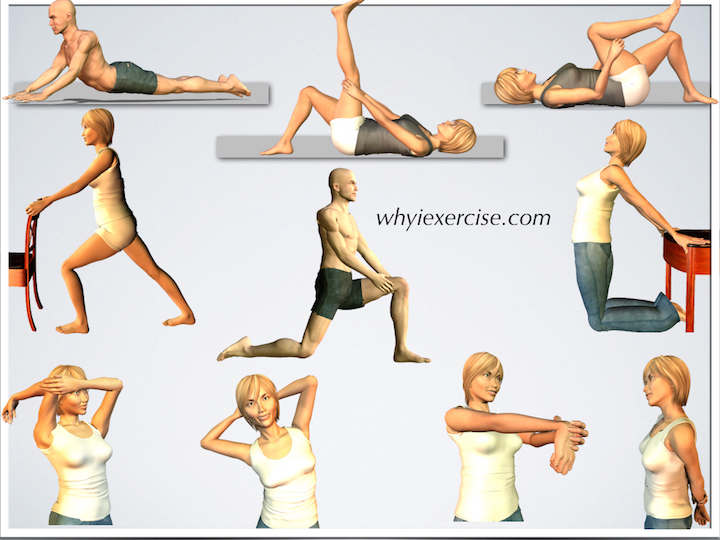
FLEXIBILITY and CORE TRAINING are essential to preparing your body for success, no matter what the preferred sport or activity.
This is where the motivating your kids to exercise starts to come in. If your child has a preferred exercise or activity, you can discuss with him or her the importance of flexibility and strength to help achieve greater success.
- Lengthens muscles and connective tissues
- Reduces risk of injury
- Increases range of motion
WHAT HAPPENS TO MUSCLES DURING WARM-UP?
Stretching out your muscles results in
-
- Increased blood circulation to muscles.
- Blood in muscles warms up which raises your core temperature.
- Increased oxygen is available to muscles.
- Increases in blood circulation and oxygen flow through your body means an increase in available energy to use during your workout.
- Greater flexibility in your muscles and connective tissues.
Flexibility is another word for the ability of your muscles and connective tissues (ligaments for example) to stretch. This frees you up for greater movement ability and helps prevent muscle strain injuries and movement injuries.
Two (2) REAL LIFE Examples of what can happen if you don’t stretch properly and/or don’t have enough flexibility
- When I was a lot younger, in shape, and working out regularly, I injured myself during an advanced step aerobic class. How? You may ask. Well, the teacher was late and shortened the warm up period. As a result, my muscles were not properly warmed up and I tripped going over the step and fractured my foot. So, the lesson here is: “Even if you’re in shape, stretching is still REALLY important.
- Fast forward a few years to post-pregnancy, out of shape, overweight mama (me). I used to love roller skating when I was in high school and a few years after. So, I was so excited to get out on the skating rink when we attended my son’s first grade skating party. I got almost around the rink once when a kid skated in front of me. I swerved to avoid him, but lost my balance and fell with my leg bent backward, pulling a ligament in my knee. Not only did I lose my balance more easily because I was overweight, but my leg wasn’t flexible enough to prevent the injury. It might have helped if I had stretched out a bit beforehand. But what would really have helped prevent the injury is if I would have prepared ahead of time for the skating party and stretched and practiced my balance before I went out on the rink for the first time in over 20 years.
3 Benefits of Core Training
- Increased stability – What this means is that you will be less likely to topple over if you try to stand on one leg, for example. Remember my story about the skating rink? Well, in addition to not having enough flexibility, I was overweight and out of shape in the middle/abdominal/core area. Thus, I toppled over onto my bottom and twisted my leg back.
- Increased strength – Anytime you increase strength you are making your life easier. Core strength is important for good posture. Poor posture over time can lead to back and shoulder pain, and even increase risk of back and shoulder injury.
- Increased Endurance – This means that you won’t get tired as fast.
As I’ve been adding to this post this week, I’ve been trying to be more creative in motivating my son to exercise. I’ve also been thinking again about the different ways he’s been active this week:
- Nathan walked around the church on Sunday. He actually does this every Sunday because he doesn’t feel comfortable interacting with people. So, he walks, before the service, and after the service. One of these days, I am going to put a pedometer on him to see how much walking he’s doing. 🙂
- He did some light stretching and strengthening on Monday morning, and then daddy and son went on a short walk around the apartment complex where we live. Total time 30 minutes or so.
- He went swimming with dad at our gym (I haven’t given up on getting him to go) on Tuesday.
- Nathan and dad went on a short walk in the morning on Wednesday. In the afternoon, they went to the local bus station because Nathan wanted to see the new fully electric bus that was just put into action. He walked around taking videos and pictures for at least an hour. He does this almost every week (visit a transit center and videotape buses or trains).
- Tomorrow he’s helping his dad do the shopping for church and they are going to the local recreation center to swim.
- Saturday night he will be helping his dad at church with the cooking. He’ll be on his feet for an hour at least.
Many of these activities aren’t actually “exercise,” but they do count as being active and they burn more calories than if he was just sitting around on the computer or watching TV.
As the weather improves, we’ll be taking more nature walks.
Don’t forget that nature walks aren’t just good for science studies. They’re also a great way to motivate your kid to exercise.
So, these are just a few of the ideas I have on how to get yourself and your kids to be more active.
What about you? What ideas do you have that will help motivate your kids to exercise?
Click here for my post, “Why Exercise Beats the Winter Blues”
Check out the Ace fitness website for lots of great ideas. You can even show your children who are possibly interested in PE as a career the endless possibilities for certifications.
[convertkit form=1087015]
Click here to see a few different kids’ fitness equipment ideas. Also, read my post about free exercise and nutrition apps here.
Below are a few links to help with specific exercises.
https://www.active.com/swimming/articles/strength-training-for-swimmers
https://www.verywellfamily.com/simple-kids-stretching-exercises-1257070
http://archive.spright.com/exercises/what-are-the-best-dryland-exercises-for-swimmers/
by Deborah Hanyon, MPH, RDN, ACE-CHC | Feb 17, 2019 | Getting Kids Moving
Why Exercise Beats the Winter Blues.
1. Exercise Beats the Winter Blues by Getting Your Blood Pumping
Morning is the best time for getting brain work in because I’m fresh, just had my coffee and I have all sorts of ideas. By 1:30-3:00 I start to feel sluggish and in need of a brain break. In the past I took naps, but that just made me feel worse. Now when I start to get drowsy/anxious, I head to the gym. I always feel better afterward. I’m more alert, relaxed and ready to head back to the drawing board.
Science supports this. Studies have shown that people with impaired cerebral blood flow have more depression.
2. Exercise Beats the Winter Blues by Releasing Endorphins
One of the main reasons you feel better about yourself after working out is because getting the blood pumping releases the “feel-good” hormones known as Endorphins.
“Exercise decreases the stress hormones such as cortisol and increases endorphins. Endorphins are the body’s natural feel good chemicals, and when they are released through exercise, your mood is boosted naturally. As well endorphins, exercise also releases adrenaline, serotonin, and dopamine.” Quote from https://www.naturaltherapypages.com.au/article/Exercise_Endorphins
3. Exercise helps your body use vitamin D.
We live in the Pacific Northwest, so we get a limited number of high quality sunlight, especially in the winter. As a result, many people in this area struggle with Seasonal Affective Disorder (SAD), which is a disorder that results in depression during certain times of the year and has been associated with lack of sunlight.
Exercise has been shown to not only relieve SAD, but to help your body use vitamin D.
People even in sunny areas like southern California can suffer from vitamin D deficiency.
I have only lived in the Oregon for about 12 years. I came from sunny southern California, but I have struggled with depression for 30 plus years. It wasn’t until I moved to Oregon that I discovered the depression I’ve suffered from in the past was mostly related to vitamin D deficiency.
I take vitamin D regularly now. As a result, most of my depression has lifted. However, it wasn’t until I started working out daily that my depression symptoms were completely alleviated.
This makes perfect sense, because vitamin D levels are higher in people who exercise regularly.
4. Exercise helps you feel better about yourself.
I don’t know about you, but I always feel better when I do something I know is good for my health, especially if it’s something that is a challenge or that helps me achieve my goals.
5. Exercise releases nervous tension and relieves anxiety.
I get this nervous “I don’t know what I’m going to do with myself” feeling often in the afternoon, especially when my brain shuts off and I feel like I “should” be doing something. After I workout, not only do I feel better knowing I made the healthy choice, but my nervousness is relieved.
Hitting the track takes energy. I simply don’t have enough excess energy to let things bother me after I’ve had a good workout. Thus, problems that seemed insurmountable before a good workout seem like not as big a deal.
And according to Mayo Clinic (and many other sites), this is a scientific fact.
6. Working out increases your metabolism, allowing you to burn more calories for the next 24 hours.
Not only will you burn extra energy when you hit the gym, but you will find that working out regularly will give you more positive energy. You will feel more motivated to do the other things in your life that need doing.
Losing weight, especially when we’re carrying extra poundage, is definitely good for the mood!
7. Working out helps you sleep better
Unless you work out right before bed. If you prefer nighttime workouts it’s common to have more difficulty sleeping at first. But this is only temporary. After your body gets used to the change in activity, you will actually sleep better. If you work out earlier in the day this should not be a problem in the beginning.
Okay, so we’ve established that exercise will help you beat the winter blues. However, just running to the gym or the park without planning ahead can interfere with your goal of feeling better.
So please consider the following suggestions before going out to exercise.
3 Important Things to Remember to Help Make Your Workout Successful
1. What you eat before and after your workout is Important.
Low carbohydrate diets are trendy right now. However, if you want to have the energy you need to complete a successful workout, you need some carbohydrates and protein.
- Glycogen is a storage form of carbohydrate. This is what your body needs for energy during a workout. When not enough carbohydrate has been eaten through the diet prior to your exercise, or if you have been restricting carbohydrates excessively, you will not have sufficient carbohydrate. As a result, you will not perform at your best during your workout. Thus, make sure you have a light meal with carbohydrates (click here for free table) within 2-3 hours of starting your workout.
- Carbohydrate has also been shown to improve immunity during a workout as well. (More on that later).
I can’t believe how many people I see at the gym sweating like crazy, who have absolutely no water nearby. So many times I have wanted to say something. But I refrain because they’re people I don’t know.
However, it really bothers me when I see people sweating like crazy with absolutely no water nearby.
- Oftentimes when people exercise, they think that losing weight during the exercise session is a good thing. However, it is not.
- When you weigh yourself before a workout and after a workout, your weight should not change.
- If you lose weight during a workout, this means you need to drink more water to prevent dehydration. For example, if you lose a half pound, you need to drink 8 ounces of water.
- If you gain weight, they may mean you drank too much water. And this is much more common than people realize, especially among major athletes like marathon runners. So next time, try drinking a bit less water and weight yourself again to measure intake.
- The best gauge of whether you need to drink water during a workout is when you feel thirsty–however, it’s not fail-safe.
- Like I said before, weigh yourself before and after.
- Weight loss is a long-term goal of working out–NOT a short-term goal.
3. It is Important to stretch before and after you workout.
This is another thing that I see too many people neglecting. I would say that well over ½ of the people I see work out at the gym do not stretch. This not only increases the risk of injury, but it will interfere with progress. Click here for a few quick stretching exercises you can do before and after exercise.
If you’re interested in more specifics on calories burned while doing various forms of activity, I found a great table. Click here for an extensive list of calories burned during various types of exercise and activities.
Click here for some helpful exercise and diet apps that I like and that I posted about previously.
And remember, “Exercise Can be Anywhere.”
I PROMISE I WILL CREATE SOME WORKOUTS FOR YOU AND YOUR KIDS TO DO.
Check out this cool site for at-home exercise ideas.
Click here for 10 beginner workouts.
Here is a site that can help you build your own home exercise routines:
How to Build Your Own Workout Routines
Other Homeschooling Dietitian Mom Recommended Resources
10 Foods High in Vitamin D
by Deborah Hanyon, MPH, RDN, ACE-CHC | Dec 11, 2018 | Getting Kids Moving
Below are my recommendations for 5 of the best free nutrition diet exercise apps. (Post may contain affiliate links).

My first 4 recommendations are for general diet, nutrition, exercise assistance.
The last one (1) is an app developed for kids with autism.
Available on IOS and Android mobile apps; also desktop website address.
Of all the 5 best free nutrition diet exercise apps, MyFitnessPal is BY FAR my favorite, and I use it all the time.
One of the best things about this app is you can create and add your own recipes into the system. The app will then give you calories and basic nutrition facts per serving. The desktop version also shows you a Nutrition Facts label that you can copy and paste into your documents or wherever you want.
Another awesome thing about MyFitnessPal is that practically all foods are in the database, including many restaurant foods. For example, Soupplantation/Sweet Tomato, Red Robin, McDonald’s, to name a few. Also, there is a bar code reader, so you can save time by just reading the bar code of the food you are eating.
The articles on MyFitnessPal are trustworthy and written by credentialed fitness pros. They contain tasty recipes, and sound nutrition and exercise advice.
I use the free version of MyFitnessPal, and there are ads showing. However, they are in the background, at least in the IOS mobile app. The desktop version also has ads, and they are a bit more noticeable. But, I don’t find them troublesome.
If you are interested in a more extensive analysis of the foods you eat, you can pay for the premium version. But I have never found any use for it.
MyFitnessPal can be downloaded on Android and IOS, and can also be used on a desktop/laptop. There are several apps that can be connected to MyFitnessPal, including MapMyRun, MapMyWalk, FitBitTracker, and Pacer Pedometer.
SparkPeople Calorie Tracker
I discovered the desktop version of SparkPeople through Pinterest recently while looking for stability ball exercises, and I like it a lot. It reminds me of MyFitnessPal, except there are some really good exercise videos available on SparkPeople.com. There are a lot more ads that popup, however.
The Calorie Tracker app connects with the website, and offers different challenges including, “Eat 5+ Servings of Fruits & Veggies a Day for 7 Days,” and “Exercise 10+ Minutes a Day for 7 Days.”
These basic, concrete goals can be easily integrated into your homeschooling health and/or PE curriculum.
You can connect with friends and share via the feed.
There are also lots of recipes including “20 Incredible Ways to Make Chicken in Your Instant Pot.” Clicking on these recipes will take you to SparkRecipes.com.
I just got a brand new Instant Pot for my birthday in November, so I found this one interesting. By the way, I LOVE my Instant Pot!
SparkPeople also has several apps that complement the calorie tracker, including Nutrition Lookup and SparkRecipes.
Nutrition Lookup by SparkPeople
This is a very specific app for food lookup analysis. The free version of this app has more detailed nutritional information than the free version of MyFitnessPal.
For example, the free version of MyFitnessPal only includes calories, fat, carbs, protein, cholesterol, potassium, sodium, calcium, vitamin a, c, and iron. In contrast, Nutrition Lookup also has information on vitamin B12, B6, D, E, Copper, Folate, Magnesium, and more.
Vitamins B6, B12, Folate, D, E, and the minerals Copper and Magnesium are all important nutrients to have in your diet. So, if you are interested in detailed nutritional analysis without having to pay, Nutrition Lookup is a better choice than MyFitnessPal.
SparkRecipes
This app does what it says. It provides recipes. However, not just any kinds of recipes. Healthy recipes. For example, the recipe, “Raspberry-Lemon Scones,” includes nonfat milk and whole wheat flour. Also, the amounts of butter, salt and sugar are significantly lower than is typical for a Scone recipe.
And, of course, there are TONS of recipes that are kid-friendly, allergy friendly, quick and easy, and so much more!
For example, Mini Vegetable Frittatas are low carb, rich in veggies AND kid friendly; 55 Healthy Snacks under 200 Calories are low calorie and kid friendly; and Gluten Free Four Cheese Macaroni and Cheese is gluten free and kid friendly!
SparkRecipes allows you to add your own recipes as well, which is similar to MyFitnessPal. You can also create favorite ingredients, which is not an option that I have noticed in MyFitnessPal.
Calorie Tracker, Nutrition Lookup, and SparkRecipes can all be connected to the main website, and you can use the same username and password for all three.
EB Pro was designed specifically for autistic kiddos to encourage regular exercise. Despite this fact, EB Pro can also be used for any child who struggles with exercise.
One downside is that EB Pro works only on tablets.
Unfortunately, it also has a few bugs.
We have been using EB Pro since summer, and it is wonderful when it is working correctly. The developers have been having issues with PayPal and monthly subscriptions, so we have been canceled a couple of times. I have had to redo my programmed workout routines a couple of times, which has been frustrating. However, the developer is easy to work with and he does all he can to help get you functional on EB Pro.
The pluses of EB Pro:
Every exercise is categorized with most having a short video showing the exercise. Most of the exercises are basic and easy to learn. The developer works with autistic youth, and all of the videos are of autistic youth doing the exercises. You can make your own videos and download them as well.
Since the exercises have visual aides, mom and dad or older brother and sister can learn the exercises and teach them to younger or special needs siblings. Higher functioning special kids can become independent once they learn specific exercises. They can then use the Exercise Buddy on their own, which helps mom a lot!
My son is able to do this, and it helps ease my stress level tremendously!
Exercise Buddy is not actually free, but it hardly costs anything. It is only $4 per month (or $36 for a year). Plus, you can get a 14-day free trial before deciding if it works for you.
The developer is pretty easy to reach via phone if you have any questions or issues. His name is Dave Geslak, his company is Exercise Connection, and he is an Autism Exercise Specialist.
Don’t forget to checkout my freebies page, including FREE Christmas Cards with Envelope Template! and the booklet, “Lactose Intolerance or Milk Allergy? How to Tell the Difference”
I’ve also recently written articles on Gluten Intolerance and 13 Benefits of Omega-3 Fats.
Why Exercise Beats the Winter Blues
How to Motivate Your Kid to Exercise
by Deborah Hanyon, MPH, RDN, ACE-CHC | Oct 23, 2018 | Getting Kids Moving
Exercise can be anywhere…Nathan loves to walk…when he’s at church, at the library, park, and especially when he’s watching buses or trains. So, we take advantage of that love and give him frequent opportunities to do just that–walk!
Studies show that even light walking has a positive effect on feelings of well-being, and increases feelings of calm. And doing something you love also helps, because you look forward to doing it.
How do you motivate your kiddos to move?
It doesn’t have to be fancy or even “organized.” Just getting up and moving will make a difference, especially for a kiddo who is spending a lot of time on the computer or in their bedroom.
by Deborah Hanyon, MPH, RDN, ACE-CHC | Sep 29, 2018 | Getting Kids Moving
After a month of school, we are still plugging away at our Physical Education class. Though I have found that there are many exercises that Nathan doesn't like. "It's important to make it fun," they say! It takes Creativity!
I just asked my son which exercises are fun, and he said, "Ball." He has autism, so he is a boy of very few words. I am learning as I go...Fortunately, there is tons of information available on the internet to help with inspiration.
A couple of examples:
Ace Fitness' website, www.AceFitness.org and Idea Fitness, www.Ideafit.com, both have free resources available. We also have found The Exercise Buddy app for tablets (we have an Ipad, but it is also available for Android), to be extremely helpful. The Exercise Buddy can be found at www.ExerciseBuddy.com. They offer a free 14-day Trial that anyone is welcome to try.
Check out this latest article on "How to Motivate your Kid to Exercise."
8/3/2019 - Update - My husband is now home more and can help me with motivating Nathan to exercise. We have been taking him to the gym two times a week so that he can do some strength training. Plus, he is going out a couple times a week to watch harvesters, combines, buses and such. It takes Creativity is so true!
We are learning that exercise comes in so many forms...
Magnesium as Therapy